In today’s competitive digital ecosystem, paid search is no longer about simply bidding on keywords and hoping for conversions. Platforms have matured, user expectations have evolved, and competition has intensified across nearly every industry. As a result, high-impact campaigns on Google Ads require a structured, strategic, and data-first approach.
Google Ads remains one of the most powerful performance marketing platforms available to businesses of all sizes. Its reach across Search, Display, YouTube, Discovery, and Shopping enables brands to connect with users at multiple stages of the customer journey. However, this breadth also introduces complexity. Without a clear framework and disciplined execution, budgets can be spent inefficiently with little measurable impact.
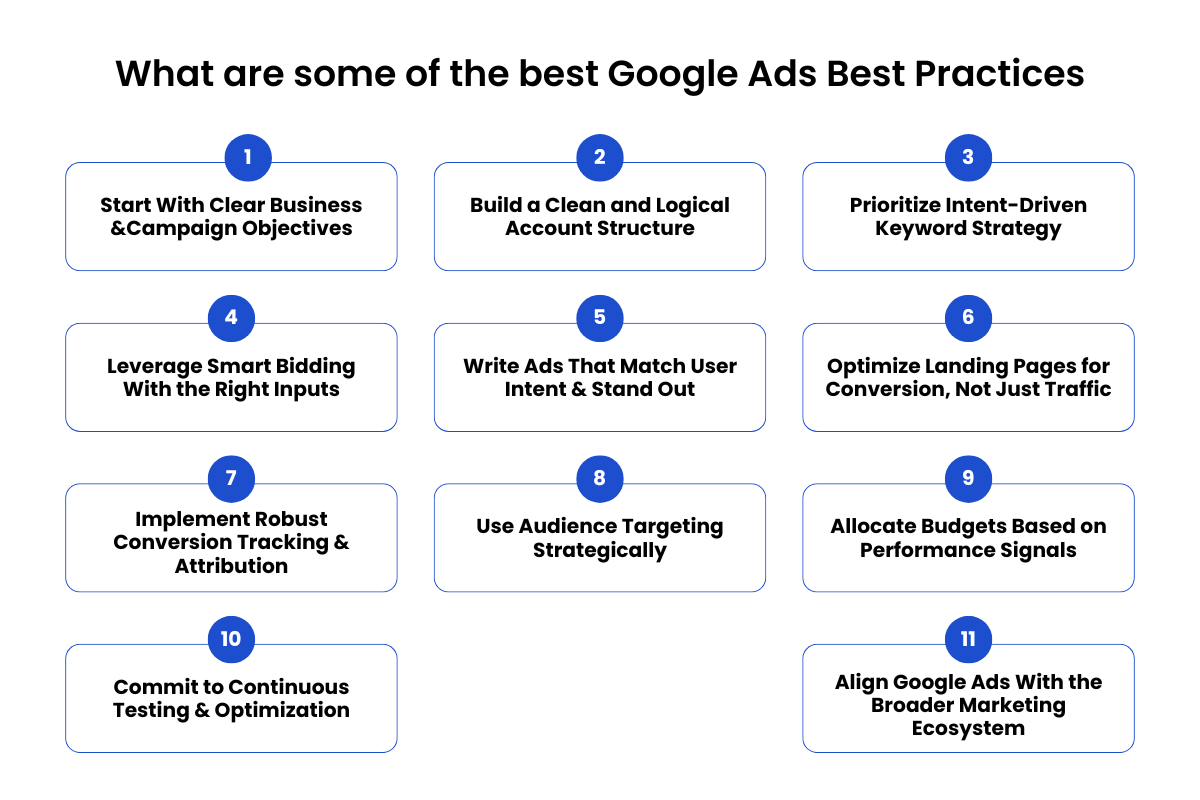
This article outlines expert-level Google Ads best practices designed to help marketers, founders, and performance teams build campaigns that are scalable, efficient, and results-driven. From account structure and keyword strategy to bidding, creatives, and measurement, each section focuses on practical guidance grounded in proven performance principles. Here are 11 expert tips to make Google Ads work for you.
1. Start With Clear Business and Campaign Objectives
Every successful Google Ads campaign begins with clarity of intent. Before selecting keywords or writing ad copy, it is essential to define what success looks like from a business perspective.
Campaign objectives should be directly tied to commercial outcomes, such as lead generation for a specific product or service, online sales with defined revenue targets, and brand visibility within a competitive category. app installs or in-app actions. These objectives must then be translated into platform-level goals such as conversions, conversion value, or impression share. Misalignment between business goals and campaign settings is one of the most common reasons campaigns underperform.
For example, running a traffic-focused campaign when the real objective is lead quality will result in inflated clicks but weak downstream performance. Establishing alignment early ensures that bidding strategies, targeting choices, and creative messaging work toward the same measurable outcome.
2. Build a Clean and Logical Account Structure
Account structure is the foundation of Google Ads performance. A well-organized account improves relevance, Quality Score, reporting clarity, and long-term scalability.
Best practices for account structure include segmenting campaigns by intent, not just by product; creating tightly themed ad groups with closely related keywords, separating brand, non-brand, competitor, and remarketing campaigns; and isolating high-value products or services into dedicated campaigns.
A granular structure allows for better control over budgets, bids, and messaging. It also makes it easier to identify what is driving results and where optimization is required. Overly consolidated structures may appear simpler, but often limit performance insights and optimization potential.
3. Prioritize Intent-Driven Keyword Strategy
Keyword selection should focus on user intent rather than search volume alone. High-impact campaigns prioritize keywords that signal readiness to take action, not just general interest.
An effective keyword strategy involves mapping keywords to the buyer’s journey (awareness, consideration, decision), prioritizing commercial and transactional queries for performance campaigns, using long-tail keywords to capture high-intent, lower-competition searches, and continuously refining match types to balance reach and control.
It is equally important to invest time in building and maintaining negative keyword lists. Excluding irrelevant searches protects budget efficiency and improves conversion rates by preventing ads from showing to unqualified users.
4. Leverage Smart Bidding With the Right Inputs
Google’s smart bidding algorithms have become increasingly sophisticated, but they are only as effective as the data they receive. Automated bidding should be treated as a performance lever, not a replacement for strategy. Human oversight remains critical. Smart bidding works best when marketers provide high-quality inputs, monitor performance trends, and intervene strategically when business conditions or objectives change.
Key principles for smart bidding success include
- Selecting bidding strategies aligned with campaign goals, such as Target CPA or Target ROAS
- Ensuring accurate and comprehensive conversion tracking
- Allowing sufficient data volume before evaluating performance
- Avoiding frequent bid strategy changes that reset learning phases
5. Write Ads That Match User Intent and Stand Out
Ad copy plays a critical role in both click-through rate and conversion quality. High-performing ads are not generic; they are tightly aligned with user intent and clearly communicate value.
Effective Google Ads copy should:
- Reflect the exact language and pain points of the search query
- Highlight unique selling propositions and differentiators
- Include clear calls to action that set user expectations
- Maintain consistency between ad messaging and landing page content
Ad extensions should be used extensively to enhance visibility and relevance. Sitelinks, callouts, structured snippets, and price extensions not only improve click-through rates but also contribute to higher quality scores. Continuous A/B testing of headlines, descriptions, and extensions is essential. Even small improvements in messaging can compound into significant performance gains at scale.
6. Optimize Landing Pages for Conversion, Not Just Traffic
Driving qualified traffic is only half the equation. Landing page experience directly influences conversion rates, Quality Score, and overall campaign ROI. Conversion paths should be intuitive and frictionless. Forms should request only essential information, and calls to action should be prominent and unambiguous. Regular testing of page layouts, messaging, and conversion elements is necessary to maximize post-click performance.
High-impact landing pages share several characteristics: clear alignment with the ad message and keyword intent, fast loading speeds across devices, simple, focused layouts with minimal distractions, and strong value propositions supported by social proof.
7. Implement Robust Conversion Tracking and Attribution
Accurate measurement is the backbone of optimization. Without reliable conversion tracking, even the most well-structured campaigns will struggle to improve. Understanding how users interact with ads across devices and touchpoints enables more informed bidding and budgeting decisions. Attribution insights help identify which campaigns and keywords truly drive incremental value rather than simply capturing existing demand.
Best practices include:
- Tracking all meaningful actions, not just final conversions
- Assigning appropriate values to different conversion types
- Using data-driven attribution where possible
- Regularly auditing tracking setups for accuracy
8. Use Audience Targeting Strategically
Audience targeting has become a powerful complement to keyword-based targeting. When used correctly, audiences enhance relevance and efficiency without restricting scale. Audience data should inform optimization decisions rather than replace intent-based targeting. The goal is to prioritize valuable users while maintaining sufficient reach to support growth.
Effective audience strategies include applying in-market and custom segments to refine targeting, using remarketing lists to re-engage high-intent users, layering audiences in observation mode for insight gathering, and adjusting bids based on audience performance trends.
Allocate Budgets Based on Performance Signals
Budget allocation should be dynamic and performance-driven. Static budgets often fail to reflect real-time demand and opportunity. Regular budget reviews ensure that spending is aligned with business priorities and that high-potential campaigns are not unnecessarily constrained.
High-performing advertisers:
- Allocate more budget to campaigns with proven ROI
- Reduce spend on underperforming or low-intent segments
- Adjust budgets seasonally based on demand patterns
- Monitor impression share to identify missed opportunities
9. Commit to Continuous Testing and Optimization
Google Ads is not a set-and-forget platform. Continuous experimentation is essential to remain competitive and adapt to market changes. Areas for ongoing testing include ad copy and creative variations, keyword match types and search term exclusions, bidding strategies and target thresholds, and landing page layouts and conversion flows. Optimization should follow a structured testing framework, with clear hypotheses and success metrics. This disciplined approach enables teams to scale what works and eliminate inefficiencies systematically.
10. Align Google Ads With the Broader Marketing Ecosystem
High-impact campaigns do not operate in isolation. Google Ads performance improves when aligned with broader marketing efforts such as SEO, content marketing, CRM, and offline sales data. Cross-channel alignment ensures that Google Ads contributes to long-term business growth, rather than relying solely on short-term metrics.
Integration enables:
- Better audience segmentation and remarketing
- More accurate conversion valuation
- Improved messaging consistency across channels
- Deeper insights into customer lifetime value