Let’s get one thing out of the way. If your marketing agency’s idea of success is “we increased impressions” while your revenue graph is flatlining like a bad ECG report, congratulations, you’re just funding vibes, not growth. The harsh truth? Most marketing doesn’t fail because of bad creatives or weak targeting. It fails because marketing goals were never aligned with business objectives in the first place.
And alignment is not a fancy PowerPoint slide with arrows and buzzwords. It’s discipline and clarity. It’s knowing why you’re doing what you’re doing, and what success actually looks like beyond vanity metrics. So let’s break down how a real digital marketing agency aligns marketing goals with business objectives, without jargon, and without pretending that “brand awareness” pays salaries.
First, Let’s Define the Problem
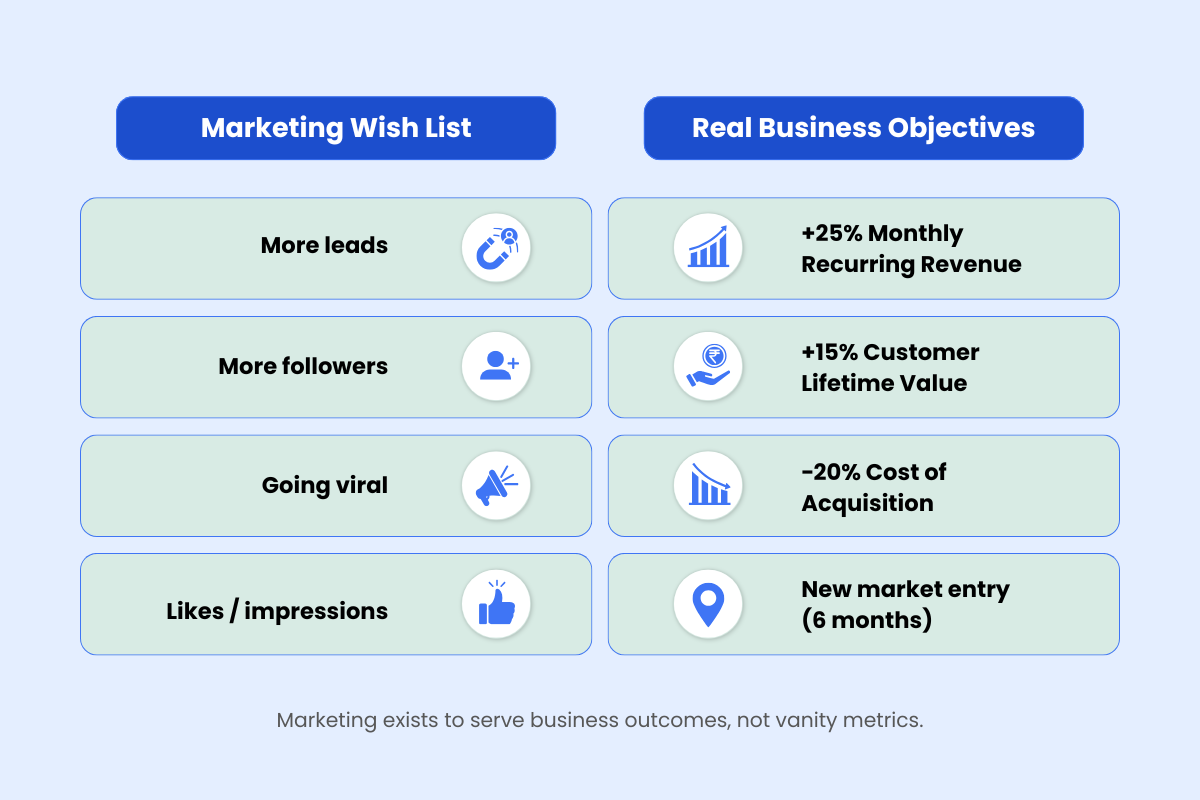
Most businesses start marketing conversations with the goal of wanting more leads, more followers, and wanting to go viral. That sounds quite cool. However, that’s not a business objective. That’s a wish list. A business objective sounds more like a plan to increase monthly recurring revenue by 25%, improve customer lifetime value by 15%, reduce the cost of acquisition by 20%, or enter a new market segment within 6 months. Marketing doesn’t exist in isolation. It exists to serve these outcomes. A solid agency knows this and refuses to start execution until the business math makes sense. Here is an easy 8-step guide on how digital marketing agencies align marketing goals with objectives.
Step 1: Translating Business Objectives Into Marketing Language
Here’s where amateurs panic, and professionals lean in. Business leaders speak in revenue, margins, churn, and growth rate. Marketing teams speak in CTRs, ROAS, funnels, and cohorts. A good agency acts as the translator between the two. Let’s say the business objective is to increase revenue by ₹1 crore this quarter. A real agency doesn’t think it’s a good idea to run ads.
They ask where your current revenue comes from? Which product or service has the highest margin? What’s your average deal size? How long is your sales cycle? What channels currently convert best? Only then do marketing goals emerge, such as generating 400 sales-qualified leads with a CPL under ₹X, increasing conversion rate on high-intent pages by Y%, and retargetting warm audiences to shorten the sales cycle. This is alignment. Everything else is guesswork.
Step 2: Identifying the Right Growth Lever
Here’s an uncomfortable truth agencies don’t like admitting: Not every business needs more traffic. Some need better conversions. Some need retention. Some need pricing fixes. Some need better sales enablement. A sharp agency looks at the funnel and asks: “Where is the real leak?” High traffic, low conversions? That is a CRO problem. Good leads, low closures? Looks like a Sales alignment issue. Strong acquisition, poor repeat purchases? That is Lifecycle marketing. High ROAS, low profitability? Probably a Pricing or margin issue
Throwing ads at a broken funnel is like pouring water into a leaking bucket and calling it hydration. Alignment means choosing the most leverageable point in the business, not the most trending tactic.
Step 3: Setting Marketing Goals That Are Actually Measurable
Let’s talk about the elephant in every agency meeting. Vanity metrics, impressions, likes, reach, engagement rate, they are all nice to look at, but are terribly useless without context. A performance-driven agency ties marketing KPIs directly to business impact:
- Cost per qualified lead, not cost per click
- Revenue per channel, not traffic per channel
- Pipeline contribution, not post saves
- Customer acquisition cost vs lifetime value
Every marketing goal must answer: “If we hit this number, does the business win?” If the answer is unclear, then the goal is wrong.
Step 4: Aligning Teams Before Aligning Campaigns
Here’s where most agencies quietly fail. Marketing alignment doesn’t happen in dashboards. It happens between people. If marketing is generating leads that sales doesn’t want, alignment is broken. If leadership expects miracles on a startup budget, alignment is broken. If agencies aren’t looped into real business constraints, alignment is broken.
A serious agency syncs regularly with founders, sales, and ops, understands revenue targets and pressure points, builds feedback loops between lead quality and campaign optimisation, and adjusts strategy based on ground reality. Alignment is not a method to set and forget. It’s continuous calibration.
Step 5: Designing Campaigns Backwards From Revenue
This is where strategy gets the spotlight. Instead of asking: “What campaigns should we run?” Aligned agencies ask: “What action must the customer take for the business to grow?” Then they work backwards. Revenue goal, Required deals, Required SQLs, Required MQLs, Required traffic, Channel mix, and finally, Creative strategy. Suddenly, every ad, landing page, email, and CTA has a job. No random content. No “let’s test everything.” No campaign without purpose. Just focused execution tied to money in the bank.
Step 6: Budget Allocation Based on Business Impact, Not Trends
TikTok is trending? That’s great. Are AI ads the new thing? That sounds like a fun idea. Is your competitor doing something shiny? That is irrelevant. Aligned agencies allocate budget based on:
- Marginal returns per channel
- Stage of the business
- Risk tolerance
- Sales velocity
- Profitability goals
Sometimes the smartest move is doubling down on what’s boring but profitable. Sometimes it’s experimenting, but with guardrails. Alignment means spending money like it’s yours, not the client’s.
Step 7: Reporting That Makes Sense to Founders (Not Just Marketers)
If your monthly report needs a marketing dictionary to understand, it’s already failed. A good agency reports in business language:
“This channel contributed ₹X in the pipeline.”
“This campaign reduced CAC by Y%.”
“This initiative shortened the sales cycle by Z days.”
Dashboards are great. Insights are better. Aligned reporting answers three questions:
- What happened?
- Why did it happen?
- What are we changing next?
Anything else is purely decoration.
Step 8: Knowing When to Say No
This is where great agencies separate themselves from desperate ones. Aligned agencies say no to unrealistic timelines, misaligned expectations, tactics that don’t serve business goals, and scaling before fundamentals are strong. They protect the strategy, even when it’s uncomfortable. Because alignment is not about pleasing everyone. It’s about building something that actually works.
Why This Alignment Is Non-Negotiable in 2026
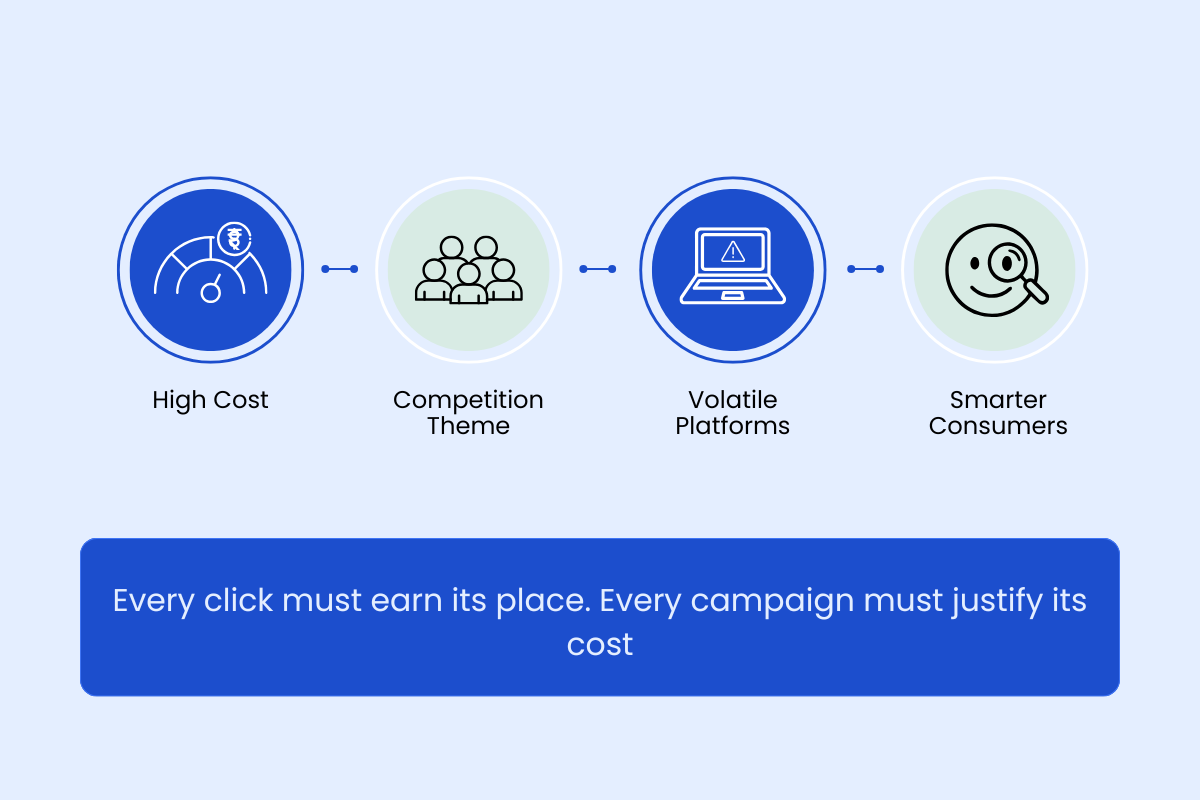
Attention is expensive. Competition is brutal. Ad platforms are volatile. Consumers are smarter. You cannot afford marketing that’s disconnected from business reality anymore. Every click must earn its place. Every campaign must justify its cost. Every agency must think like a business partner, not a service vendor.
Conclusion
A digital marketing agency real job is not running ads, posting content, or sending reports. It is to bridge the gap between business ambition and market execution. If your agency can’t clearly explain how its work moves revenue, retention, or profitability, you don’t have a marketing partner. You have an expense. A results-driven digital marketing agency focuses on measurable business outcomes, not just surface-level activity. And if you’re done playing the guessing game and want marketing that’s actually aligned with where your business is headed, you already know what to do. Reach out to [email protected] to talk strategy before tactics. Because growth without alignment is just chaos with better branding.
Reach out to us at Intent Farm, where we not only optimize your content but also deliver a significant boost in your performance. And no—we’re not limited to social media platforms. We offer Amazon ads, Google ads, Facebook ads, and high-impact digital ads that mean business.