Introduction
In Google Ads, most advertisers believe that auctions are primarily shaped by bids, Quality Score, and competition. While those elements are undeniably central, budget allocation is often the silent force that determines whether an advertiser even enters the auction in the first place. Budget decisions do not merely cap spend; they shape learning signals, influence bid behavior, and affect auction-level participation across time, geography, and intent layers.
Budget reallocation: moving spend between campaigns, ad groups, match types, or bidding strategies is one of the most powerful levers available to performance marketers. Yet it is also one of the least understood. Many teams treat budget as a financial constraint rather than a strategic input into the auction ecosystem. As a result, reallocations are often reactive, poorly sequenced, and disconnected from how Google’s auction mechanics actually function.
This article examines how budget reallocation inside Google Ads changes auction outcomes at a structural level. It explores why reallocating spend can reshape impression eligibility, alter bid aggressiveness, influence competitor dynamics, and even change how Smart Bidding systems behave. More importantly, it outlines how advertisers can reallocate budgets with intention rather than assumption.
Understanding the Google Ads Auction Beyond Bids
At its core, every Google Ads auction determines which ads are shown, in what order, and at what cost. This decision is made in milliseconds and is influenced by multiple factors, including bid amount, ad relevance, expected click-through rate, and landing page experience.
However, an advertiser only participates in an auction if their campaign is eligible at that moment. Budget plays a crucial role in determining this eligibility. When daily or shared budgets are constrained, Google may limit how often ads enter auctions, even if bids and Quality Scores are competitive. This phenomenon, commonly reflected as “limited by budget” status, has deeper implications than many advertisers realize.
Budget is not simply a spending cap. It is a distribution signal that guides how often Google allows a campaign to compete, which auctions it prioritizes, and how aggressively automated bidding systems operate within those constraints.

Budget as an Auction Eligibility Gate
The first and most direct way budget reallocation changes auction outcomes is by controlling eligibility. Campaigns with sufficient budgets are allowed to enter a broader range of auctions throughout the day. Campaigns with tight budgets are selectively throttled.
When you reallocate budget away from one campaign and into another, you are effectively changing which queries you can compete on, at what times of day your ads are eligible, and how frequently your ads appear in high-competition auctions. A campaign with a reduced budget may no longer appear for high-cost, high-intent queries, even if those queries are central to business outcomes. Conversely, increasing the budget can allow a campaign to enter auctions it previously could not sustain, improving reach and impression share without altering bids. This eligibility effect is often mistaken for performance volatility caused by competition, when in reality it is driven by budget distribution decisions.
Impression Share Dynamics and Budget Reallocation
One of the clearest indicators of how budget affects auctions is impression share. When the budget is reallocated, impression share metrics respond immediately, even if bids remain constant. There are three critical impression share dimensions influenced by budget:
- Search Impression Share: The percentage of total eligible impressions your ads receive.
- Lost Impression Share (Budget): The share of impressions lost due to insufficient budget.
- Top and Absolute Top Impression Share: Visibility in premium auction placements.
When the budget is pulled from a campaign, the lost impression share due to the budget typically increases. This means the campaign is entering fewer auctions overall, often starting with the most competitive ones. Over time, this can shift brand visibility, reduce conversion volume, and weaken auction-level positioning against competitors who maintain stable budgets. On the other hand, reallocating budget into high-performing campaigns can unlock incremental impression share in auctions that were previously inaccessible, especially during peak demand windows.
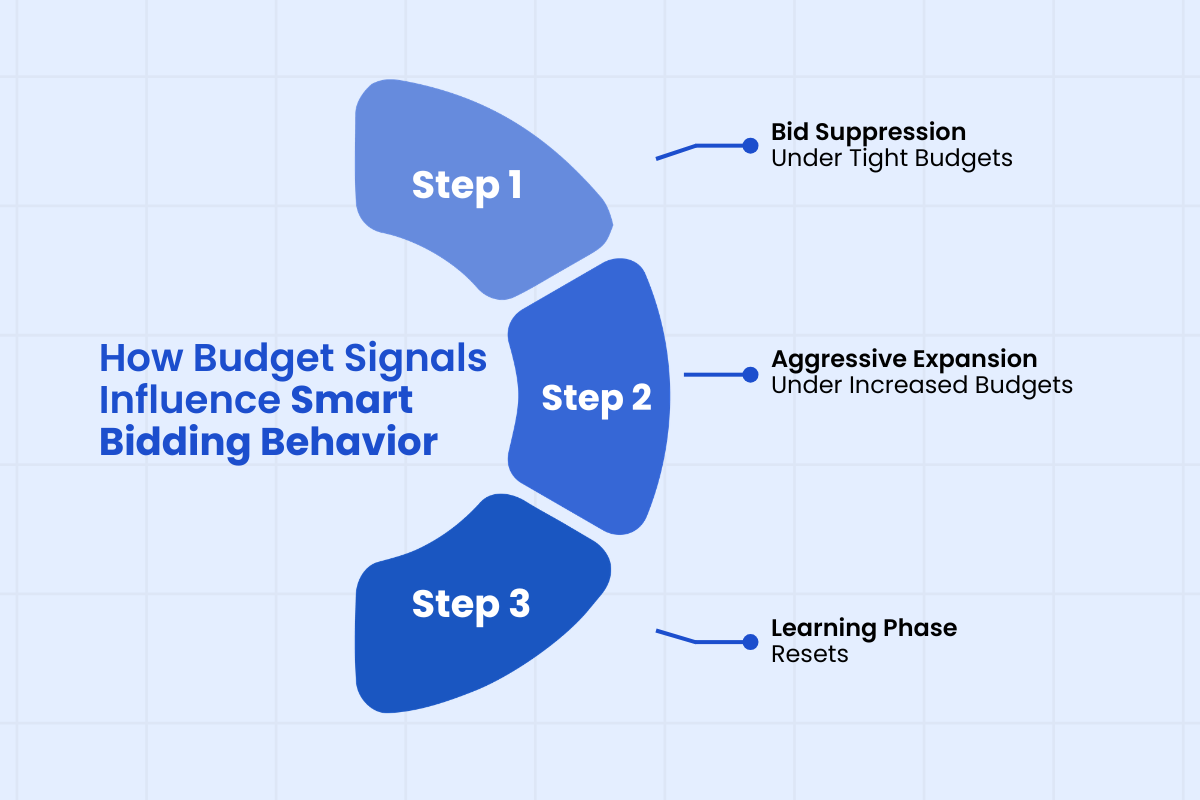
How Budget Signals Influence Smart Bidding Behavior
Modern Google Ads accounts rely heavily on Smart Bidding strategies such as Target CPA, Target ROAS, and Maximize Conversions. These systems are highly sensitive to budget signals.
When the budget is reallocated, Smart Bidding systems interpret the change as a shift in performance tolerance and opportunity. This can lead to immediate changes in bid behavior, even before sufficient new data is accumulated.
Key behavioral shifts include:
- Bid Suppression Under Tight Budgets: When budgets are reduced, Smart Bidding often becomes more conservative, prioritizing auctions with higher predicted conversion probability and avoiding exploratory auctions.
- Aggressive Expansion Under Increased Budgets: When budgets increase, the system may bid more aggressively to capture additional volume, sometimes entering auctions with slightly lower predicted efficiency.
- Learning Phase Resets: Significant budget changes can partially disrupt learned patterns, especially if the change exceeds 20–30% over a short period.
These reactions mean that budget reallocation does not merely redistribute spend; it actively reshapes how the algorithm competes in each auction.
Cross-Campaign Budget Reallocation and Internal Competition
In accounts with multiple campaigns targeting overlapping queries, budget reallocation can change internal auction dynamics. Google Ads runs internal auctions to decide which of your campaigns enters the external auction.
When the budget is shifted toward one campaign, that campaign may begin to dominate internal eligibility, pushing other campaigns out of auctions, even if those campaigns have higher Quality Scores or more relevant creatives. Without careful segmentation, reallocating budget can unintentionally cannibalize high-value traffic or distort performance attribution across campaigns.
This internal competition effect is particularly pronounced when reallocating budget between brand and non-brand campaigns, generic and competitor campaigns, and broad match and exact match structures.
Time-Based Auction Participation and Budget Pacing
Budget reallocation also affects when during the day your ads participate in auctions. Google’s pacing algorithms attempt to distribute spend evenly across the day, but limited budgets often lead to early-day throttling or late-day exclusion.
When the budget is reduced, campaigns may exit auctions during peak conversion hours, appear disproportionately during low-competition periods, and miss high-intent queries that occur later in the day. Conversely, increasing the budget can restore full-day auction participation, improving conversion consistency and stabilizing cost metrics.
This temporal dimension of auction participation is frequently overlooked, yet it has a material impact on outcomes, especially for businesses with strong day-part performance patterns.
Budget Reallocation and Competitive Response
Auctions are dynamic ecosystems. When you reallocate budget, competitors may benefit or respond. Reducing the budget in a competitive auction can lower overall pressure, allowing competitors to win impressions at lower costs. Over time, this can improve their Quality Scores and reinforce their position. Re-entering the auction later may require higher bids to regain lost ground.
Increasing budget, on the other hand, can intensify competition, raising CPCs in the short term but potentially forcing weaker competitors out of premium placements. Strategic budget increases can therefore be used defensively, not just offensively. Understanding that budget shifts influence not only your own performance but also competitor behavior is essential for long-term auction strategy.
Common Budget Reallocation Mistakes That Distort Auctions
Despite its importance, budget reallocation is often executed poorly. Common mistakes include:
- Frequent, reactive budget changes that prevent algorithms from stabilizing
- Moving budget without adjusting expectations for CPA or ROAS
- Reallocating based solely on short-term performance snapshots
- Ignoring impression share and lost auction data
These practices create noise in auction participation and make it difficult to distinguish between structural performance changes and budget-induced volatility.
Strategic Principles for Budget Reallocation That Improve Auction Outcomes
When budget decisions are made with auction mechanics in mind, reallocations become a tool for growth rather than a source of disruption. To reallocate budget effectively, advertisers should follow several guiding principles:
- Make incremental changes rather than drastic shifts, especially in Smart Bidding campaigns.
- Align budget movement with intent layers, not just historical performance.
- Monitor impression share lost to budget as closely as CPA or ROAS.
- Allow sufficient stabilization time before evaluating results.
Measuring the True Impact of Budget Reallocation
Evaluating the success of budget reallocation requires more than reviewing costs and conversions. Advertisers should analyze changes in auction participation rates, shifts in impression share across key segments, variations in top-of-page visibility, and stability of Smart Bidding performance over time. Only by examining these indicators can teams understand whether budget reallocation improved auction outcomes or merely shifted spend without strategic benefit.
Conclusion
Budget reallocation inside Google Ads is not a back-office financial exercise. It is a front-line auction strategy that determines where, when, and how often an advertiser competes. By influencing eligibility, bid behavior, impression share, and competitive dynamics, budget decisions reshape auction outcomes in ways that are often underestimated. Advertisers who treat budget as a strategic signal, rather than a static constraint, gain a meaningful advantage. They enter more valuable auctions, stabilize performance, and guide automated systems toward sustainable growth.
For teams seeking expert guidance on budget strategy, auction dynamics, and performance optimization, consider reaching out to [email protected] for informed, data-driven support.